 Skip to content

When marketing teams, charities, plucky business owners or individuals stumble across our work, a common refrain to hear is: “What is dye sublimation printing?” If you landed on this guide by happenstance or, more likely, intentional curiosity, because you have some promotional items in the pipeline, you might already have an inkling (pun unintended).
I find that to fully appreciate an item – be it a piece of merchandise or, indeed, even a lanyard – first you need a proper understanding of the process that brought it to life. With dye-sublimated goods, it sure is an interesting one.
This longstanding printmaking technique, dating back to 1957, is an affordable and efficient way to print high-quality branded products, with none of the fast peeling, fading and other defects you see using cheaper methods.
In this faff-free guide, I’ll expand on the process, its benefits, and why, in my book, it’s an excellent choice for a whole manner of products, even in small batches. Vamos!
Contents:
- TL;DR
- What Dye Sublimation Is
- How the Process Works
- Understanding the Key Benefits
- Sublimation vs Screen Printing
- Where Dye Sublimation Exceeds: Some Use Cases
- Choosing The Right Printing Method for You
- Conclusion: Your Next Steps
- FAQs
TL:DR
Dye sublimation printing is a method that uses heat to bond full-colour designs directly into materials, creating durable, high-quality results. It’s ideal for detailed designs and widely used for products like lanyards and promotional items.
What is Dye Sublimation Printing?
Dye-sublimation isn’t like your average inkjet printing; the process is far more complicated, involving many moving parts. An evolution of its predecessor, thermal-wax printing (wherein a waxy dye was melted to fuse with the target material), it sought to resolve the ceraceous, candle-like feel created with the build-up of ink.
Under the helm of Noël de Plasse, French manufacturers dialled up the operating temperatures and developed more sophisticated dyes to such an extent that the dyes began to transfer via sublimation rather than melting.
For the uninitiated, “sublimation” is a technical term that denotes how a solid jumps straight from a liquid to a gas. So, in modern dye sublimation, the transfer dyes are subjected to an insane amount of heat and, thus, vaporised. Instead of soaking the target surface in ink like a standard printer, the dye in this gaseous state bonds to the paper or fabric substrate, resulting in a far crisper, more precise image.
The Dye Sublimation Process in a Little More Detail
The theory is all well and good, but what exactly goes on in the dye sublimation printer when it’s all set up? Well, that would depend on the exact technique in question, as two exist.

Photo Dye Sublimation
The first, photo dye sublimation, is the rarer of the pair and primarily used in photography.
A specialist sublimation printer (like the one pictured above) heats up a ribbon of transfer dye, causing it to sublimate. When the dye hits the photo paper, which has been prepared with three primary colours, it embeds into the substrate in full colour. To cap things off and prevent smudging, a clear plastic film is incorporated, creating a light-sheen finish.
Heat Press Sublimation
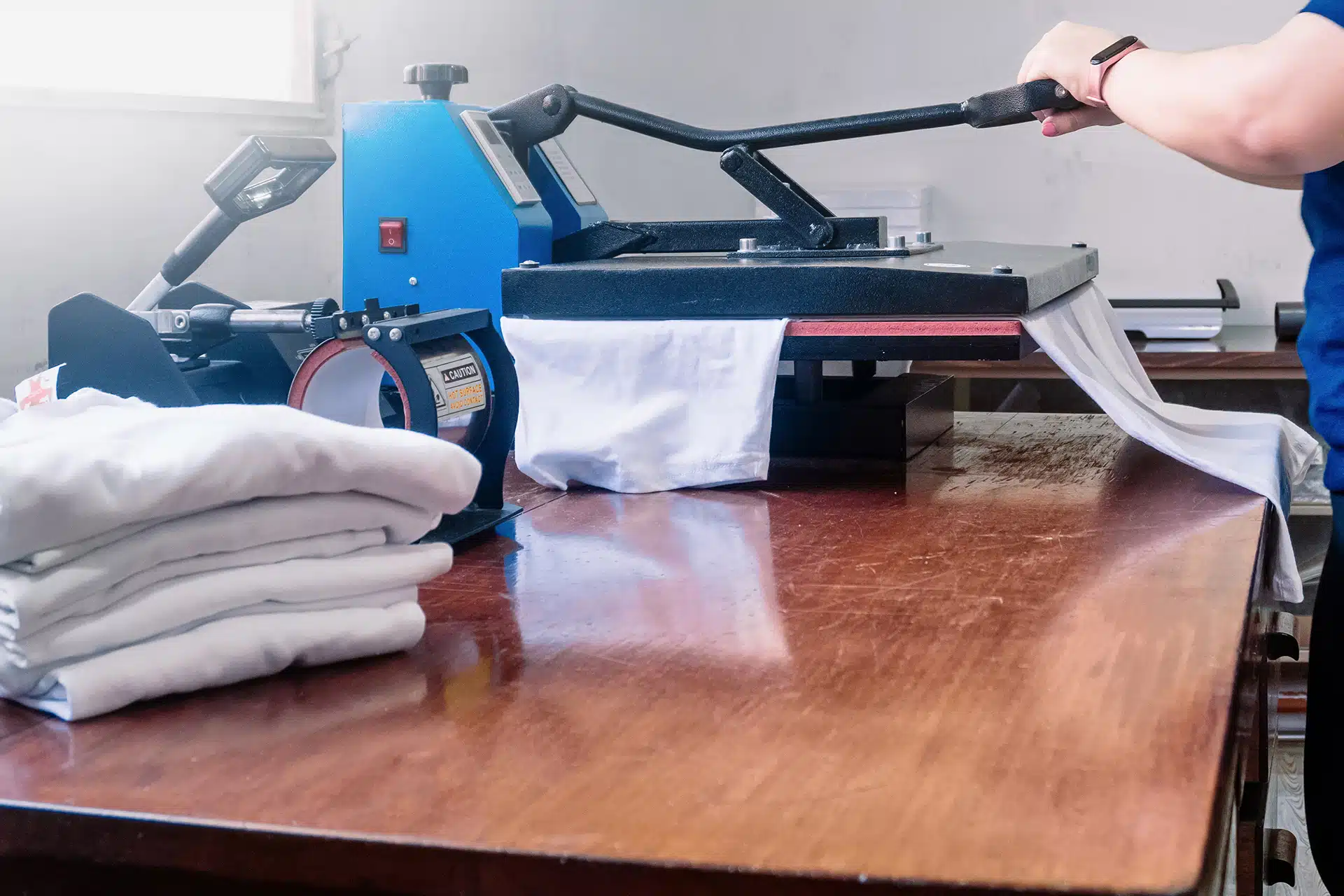
The second technique is much more mainstream, so I’ll look at it in more detail. Below are the step-by-step best practices we follow to produce our most complex, colourful lanyard designs. It’s also how employee ID cards, mugs, T-shirts and a plethora of other printed goods acquire their logos and branding.
0. Equipment Setup
Before anything at all, you need a compatible printer or access to one. These printers use specialist sublimation inks and are typically more expensive than standard inkjet printers, so outsourcing is often the most cost-effective option for most businesses.
1. Design & Transfer Printing
A design is prepared and printed onto transfer paper using specialist sublimation dye, ready to be fed into the machine.
This takes serious precision, using dedicated piezoelectric print heads that eject the ink accurately at the right temperature to preserve its special properties. The paper is explicitly designed with sublimation in mind, with a technical coating to achieve the most efficient transfer of dye and, in turn, maximum vibrancy and colour consistency.
2. Alignment and Preparation for Transfer
Then, the printed transfer paper is carefully aligned with the product substrate (usually polyester fabric or a polymer-coated surface). For items like 3D objects (phone cases, mugs, bottles, lanyards), this happens inside a heat press, not inside the printer.
3. Heat Application & Transfer
The material is exposed to high levels of heat and pressure, typically around the around 180-205°C mark. Once it hits the ink’s activation point, the solid quickly vaporises, turning immediately into a gas.
4. Bonding with the Material
The gaseous dye penetrates the polyester fibres or polymer coating and bonds at a molecular level. As it cools, it returns to a solid state within the material itself, creating a permanent, durable print embedded into the product rather than sitting on the surface. As you can imagine, this produces an unbeatably crisp, colourful finish; a result that won’t crack, peel, or wash away, even under hot water.
Understanding the Key Benefits
There’s a reason, despite the technical complexity, that dye-sublimation printing remains so widespread. In fact, you’ll find that there are many…
- Dye-sublimation is ideal for a breadth of goods, including mugs, textiles like T-shirts and caps, mouse pads, photo prints, coasters, wristbands, athletic apparel, and even things like shower curtains, as their material makeup is compatible with the process.
- It’s the only commercial printing method that can achieve continuous tones, without resorting to half tones (tiny dots of colour) to make up the image. As such, the result is a brilliant, full-colour, high-resolution print.
- Given the transfer happens on a molecular level, the printed designs are the pinnacle of durability and fade-resistance.
- You get a nice smooth print, with no raised texture; a sensory win for sportswear and other applications, like lanyards, which are to be worn for long durations.
- For complex designs – for example, a lanyard with a detailed repeating pattern like the Hidden Disabilities Sunflower design – it’s particularly cost-effective.
- The process is relatively quick, making it efficient for short print runs, so a great option for both on-demand printing or small-batch orders.
The drawback is that dye-sublimation only works on compatible materials; those with a high polyester percentage (typically 65%+) and a light colouration.
Sublimation vs Screen Printing
The dye-sublimation market is experiencing strong growth, but it’s not the only player in the field of merchandising. Screen printing, a printmaking process wherein ink is forced through a mesh screen, is equally popular, albeit for different uses.
The latter works because certain areas of the screen are impervious to the ink; this creates a stencil, which blocks the desired zones, producing a print from the dye that does seep through.
The main difference lies in the method: dye-sublimation deals with the pigments all at once, whereas in screen printing, the printmaker must repeat the process using a new stencil for each colour. As a result, we also see differences in cost structure, with screen printing typically being more cost-effective for large production runs, while sublimation suits small, custom, or unique orders.
You’ll also notice screen-printed items tend to stick to simple, bold designs. Case in point, the elegant lanyards we printed for the University of Glasgow. Here, we’re able to print onto cotton and dark fabrics, something you can’t do with sublimation. Nonetheless, dye-sublimation is the clear winner for complex, multi-colour designs that need a bit of extra staying power.

Where Dye Sublimation Exceeds: Some Use Cases
Make no mistake, stunning bright aesthetics aren’t going anywhere in 2026, but more and more often, workplaces are seeking out printed goods that go the extra mile as it pertains to longevity. As such, dye-sublimation is a natural first choice.
Here are a handful of use cases, where the printmaking process excels time and time again.
- Events and conference environments: Promotional items – be they freebies or band merch – are underestimated tools for getting your name out there, and dye-sublimation is an excellent medium to do so. Ensuring the emblazoned logo stays fresh for years and that employees are visible in their branded T-shirts, caps, lanyards and other apparel, it’s also a helpful wayfinding tool.
- Corporate ID: Many offices now have their own ID printers, which run on dye-sublimation technology, as a cost-saving measure. The benefits are immediate: staff can create crisp, easily identifiable photo ID for new hires, allowing them the flexibility to modify the specs where the need arises.
- Visitor management & access control: Not every organisation puts two and two together, but this clever printing technology subtly supports visitor management protocols by keeping lanyards and identification as sharp as possible. In a context of increased security needs, every little helps.
- Charities & fundraising: Whether we like it or not, we live in the social media age, so our promotional items have got to do the heavy lifting to look beautifully visible from all angles. Many non-profits already have this down, printing eye-catching designs with solid colour contrast, readable typography, and unique branding.
- Schools & healthcare: Dye-sublimation is a great, although frequently overlooked choice, in environments where hygiene is key. Since the print comes out flat and untextured, there’s fewer places for unwanted germs and grime to hide.
Choosing The Right Printing Method for You
If you’re still not 100% sure that dye-sublimation printing is for you, even after understanding what it is and how the process works, I recommend mulling over the following questions we often pose to clients.
- What materials are you printing? Dye-sublimation requires a polyester or polyester-coated substrate.
- How complex is the design? If it’s super simple, you probably don’t need such a printing method.
- What are your requirements colour- and detail-wise? Dye sublimation is the go-to if you’re in need of a high-resolution, full-colour image.
- How many items are you intending to print? Screen printing is more cost-effective for large production runs, while sublimation is better for small, custom, or unique orders.
- What is your budget? Make sure to conduct a cost-benefit analysis before you order.
- Where will the item be used and for how long? Durability ought to be near the top of your priorities list if it’s a piece of apparel, like a lanyard or uniform, which will be worn every day.
If in doubt, though, many professional printers will offer samples, advice, and quotes at no cost to the consumer.
Conclusion: Your Next Steps
So, that concludes this guide on what dye-sublimation is. Hopefully, you found it more interesting, and far less technical, than you first expected.
Nevertheless, dye-sublimation printing remains one of the most versatile and effective methods for creating custom merchandise, especially when your design includes bold colours, fine detail, gradients, or photographic imagery.
If you’re still weighing up your options, it’s worth comparing dye-sublimation against other methods such as woven or screen-printed lanyards to find the best fit for your design, budget, and intended use.
Ready to get started? Consult with the experts at Only Lanyards today for tailored advice, product recommendations, and help creating the perfect custom lanyards for your brand or event.
Frequently Asked Questions
What is dye sublimation printing used for?
Dye sublimation printing is commonly used for products like lanyards, ID cards, sportswear, mugs, mouse mats, and promotional merchandise. It’s especially popular where bright colours, fine detail, and long-lasting prints are important.
What is the difference between dye sublimation and screen printing?
The main difference lies in how the design is applied. Dye sublimation bonds colour directly into the material using heat, while screen printing layers ink onto the surface through a stencil. As a result, dye sublimation is generally better for detailed, full-colour designs, whereas screen printing suits simpler graphics and larger print runs.
Does dye sublimation printing fade or peel over time?
No, because the dye becomes part of the material itself rather than sitting on top of it, sublimation prints are highly resistant to fading, cracking, and peeling. This makes the process ideal for everyday-use items like lanyards and uniforms.
What materials can be used for dye sublimation printing?
Dye sublimation works best on polyester fabrics or polymer-coated materials. It’s less effective on natural fabrics like cotton unless they’ve been specially treated for sublimation printing.
Is dye sublimation good for small orders?
Yes. Unlike some traditional printing methods, dye sublimation is cost-effective for smaller batches and one-off custom designs, making it a strong option for events, charities, small businesses, and personalised merchandise.
Why is dye sublimation printing popular for lanyards?
Dye sublimation allows for sharp logos, gradients, and detailed repeating patterns without affecting the feel of the lanyard material. The result is a comfortable, durable product that keeps its colour and clarity even with regular daily use.